

Ringworld Architect Puts You in Charge of Megastructures
You are a ringworld architect, trusted by the Imperium to assemble colossal, habitable rings where planets are scarce or inconvenient. Ringworld Architect turns that premise into a single player adjacency and domino-based puzzle. Your job is simple on paper and fiendish in practice: place prefabricated dominos, shape the ring topology, add infrastructure, and pick commercial partners to steer culture and unlock upgrades. All of it adds up to a single number that matters most: real estate value.

Topology Dominos: Plan with Placement Rules
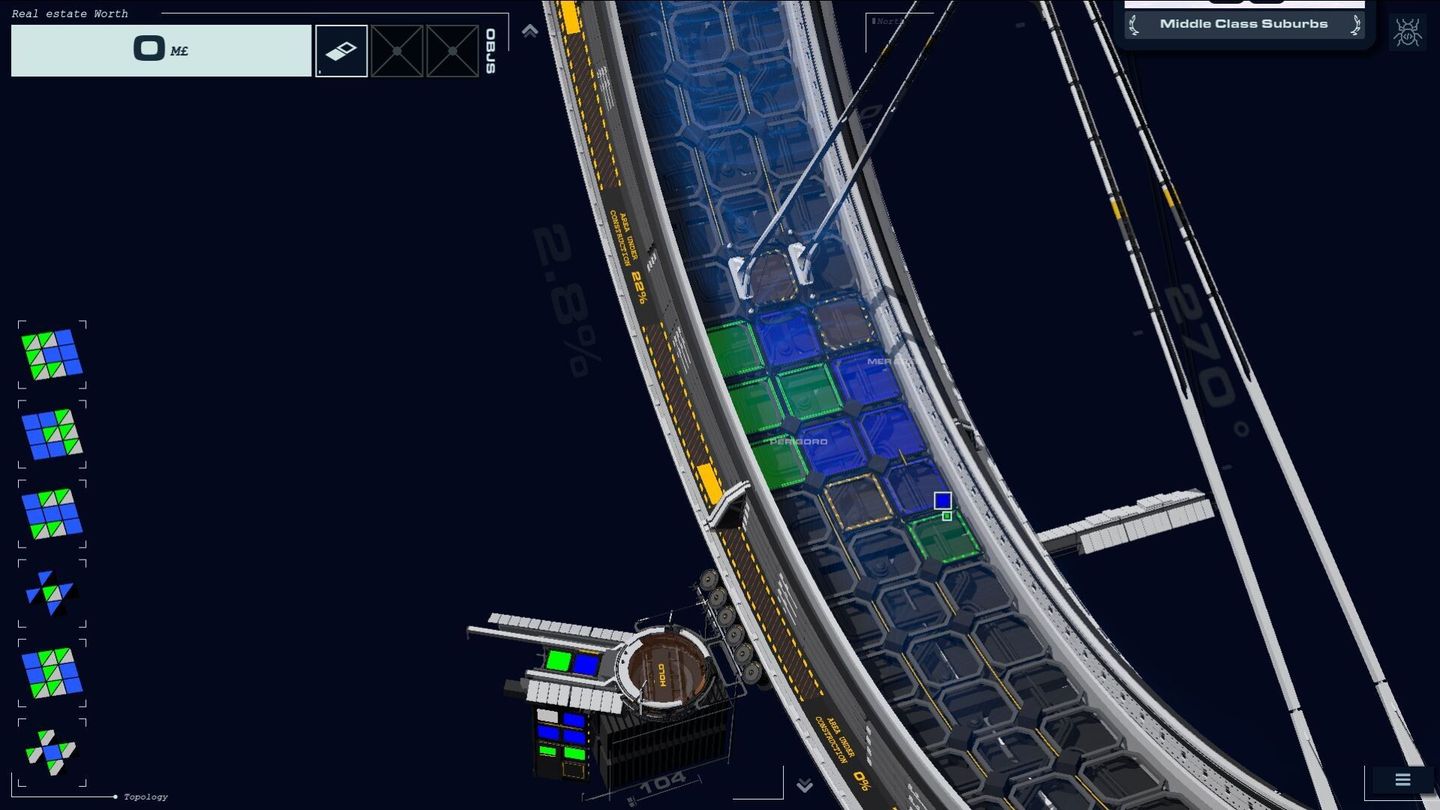
Prefab dominos save resources, but they come with strict adjacency rules. You can only place a domino next to a similar domino. That constraint forces you to think several moves ahead. The way you cluster pieces determines the terrain you can draw on the suburban ringworld. Place them thoughtfully and you will carve bays, islands, lakes, and more. Place them poorly and large tracts of useful land will become locked behind awkward seams.
The domino system is the puzzle spine. It is less about random luck and more about deliberate planning, finding the chains and shapes that unlock the most valuable layouts.
Gigantic Infrastructure and Real Estate Value
You start with a handful of region-spanning infrastructure pieces. These are high-impact placements. A correctly sited infrastructure can dramatically boost nearby property values, but space on an artificial world is finite. Every placement decision forces tradeoffs between coverage, adjacency bonuses, and later upgrade potential.
Because infrastructure both shapes the map and the economy, your scoring strategy needs to balance short-term gains against long-term zoning. Squeeze more value out of a cluster, or spread infrastructure for broader influence. Both approaches can work depending on the ring topology you build.

Shaping Society with Corporate Partners
Infrastructure is only half the equation. Ringworld Architect adds a meta layer where you sign contracts with industrial partners to gain access to new structures or upgrades. Partners unlock tools, but they also ask for influence over the colonists. That influence changes local culture and creates emergent archetypes across replays.
The choice of partners becomes a gameplay lever. Do you pick companies that give powerful upgrades but push a particular culture profile, or go for milder partners and accept slower growth? Replay the same ring to test different partner combinations and hunt for the most profitable cultural mix.
Leaderboard and Replayability
Scoring is explicit and competitive. The goal is to reach the highest real estate value possible, and the game tracks scores so you can compare yourself to friends or the wider player base. Leaderboards let you peek at other architects' builds, which can be as educational as they are humbling.
Ringworld Architect is designed around iteration. Small changes in domino placement, one different infrastructure siting, or a swapped corporate contract can produce very different outcomes. That makes each playthrough a fresh puzzle, and the leaderboard a reason to refine your approach.
For Puzzle Players Who Like Systems
If you enjoy spatial planning, constrained placement puzzles, and small-but-deep systems design, Ringworld Architect offers a focused sandbox. It combines tactile topology work with light economic strategy and social shaping through partner choice. The result is a game that rewards careful planning as much as creative experiments in culture engineering.
[Update from 12.08.26] : You can join Ringworld Architect's Discord Channel right here: https://discord.gg/5WY372ax2Z